NEWS

Visit us at LASER 2013

(April 30, 2013)

LightTrans invites you to visit us at LASER World of Photonics in Munich (May 13-16). Our team is looking forward to welcome you at our booth B2.242. We will be glad to demonstrate you the new features of VirtualLab 5 in detail. As a highlight we offer a free seminar Modeling of Laser Systems and ...

Webinar Grating Analysis with LightTrans VirtualLab 5.5

(April 24, 2013)

We would like to invite you to our free webinar "Rigorous grating analysis of general 2D and 3D structures with VirtualLab 5.5", held by Daniel Asoubar. In the webinar we demonstrate the rigorous simulation of 2D and 3D gratings with the Grating Toolbox of VirtualLab 5.5 including the foll...

Meet us at "Photonics West 2013”!

(January 16, 2013)

LightTrans is going to exhibit at Photonics West 2013 taking place in San Francisco, CA, starting on February 2, 2013. We would like to welcome you at our booth no. 4601 in the German Pavilion. We present the latest release VirtualLab™ 5.5 introducing programmable components and detectors. That en...

Design of diffractive and micro optical elements

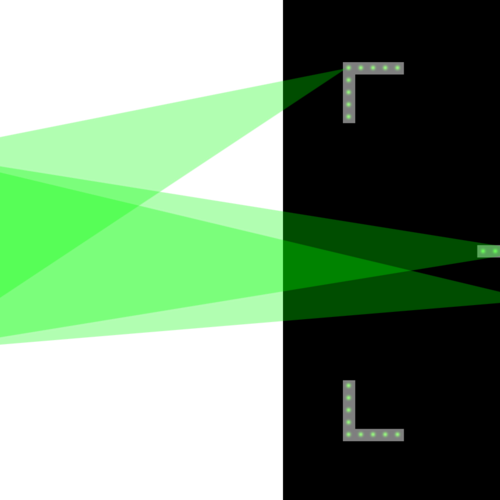
Far field of a diffractive beam splitter illuminated by polychromatic laser light.

The Diffractive Optics Toolbox enables the design of diffractive beam splitters, diffusers and beam shapers. These elements are also known as diffractive optical elements, computer generated holograms, phase plates or kinoforms. Diffractive beam splitters allow the splitting of a laser beam into beam arrays. Diffractive diffusers enable deterministic scattering of light into an arbitrary 2D light pattern. Diffusers and beam splitters can be used for the transformation of coherent and partially coherent light sources. Diffractive and refractive beam shapers enable the reshaping of the intensity profiles of coherent laser beams into circular, rectangular Top Hats, lines or customized 2D intensity distributions.

VirtualLab™ uses the powerful Iterative Fourier Transform Algorithm (IFTA) for the optimization of these elements. Session editors assist users during the design process of typical diffuser and beam splitter setups.

Your Benefit

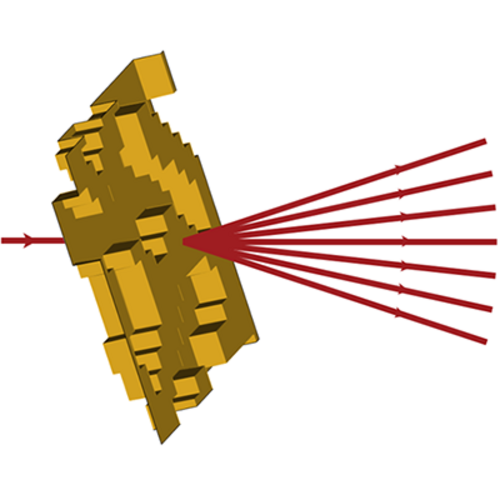
Binary height profile of a period of a diffractive beam splitting element.
  • Optimization of diffractive diffusers, diffractive beam splitters, diffractive and refractive beam shapers also known as diffractive optical elements, phase plates, kinoforms, computer generated holograms by the Iterative Fourier Transform Algorithm (IFTA).
  • Design of diffractive diffusers for homogenization of LEDs and Excimer laser beams.
  • Development of micro structured optical elements for the generation of arbitrary 2D intensity patterns and beam arrays.
  • Session editors for assisted design of diffractive diffusers and diffractive beam splitters.

Selected Features

Design of diffractive beam splitters. Beam splitters are typically periodic structures that split one laser beam into a beam array. Users can define uniform or customized weights in order to control the amount of power diffracted in the single beams. Session editors assist you during the design process.

Design of diffractive diffusers. Diffusers are periodic or non-periodic structures enabling a deterministic scattering of light in circular, rectangular Top Hats, lines or customized 2D light distributions. Because of the scattering diffusers are insensitive for alignment errors or variations of the intensity of the illuminating laser beam. Session editors assist you during the design process.

Design of diffractive and refractive beam shapers. Diffractive and refractive beam shapers enable the reshaping of the intensity profile of coherent laser beams into circular, rectangular Top Hats, lines or customized 2D intensity distributions. In difference to diffuser systems generated intensity distributions will be free of speckles and will have high homogeneity and  high efficiency. Session Editors assist you during the design process.

Homogenization of LED light and Excimer laser beams. The deterministic scattering of diffractive diffusers can be used for the homogenization of LED light and Excimer laser beams. Systems using diffractive diffusers are often more compact and allow a generation of arbitrary 2D intensity patterns in comparison to homogenization systems based on lens arrays. While the Diffractive Optics Toolbox allows the design of diffractive diffusers for a coherent source, the Starter Toolbox enables the analysis of optimized diffuser systems taking into account the spatial and temporal coherence of your light source.

Generation of fabrication data and tolerance simulation. The Diffractive Optics Toolbox allows exporting the surface profiles of micro structured elements in ASCII, bitmap and GDSII-format including the calculation of etching masks. The parameter run and the optimization documents of VirtualLab™ enable the investigation of etching depth, alignment and wavelength tolerances. The parameter run allows a single parameter variation, a multidimensional scanning parameter variation and a random (Monte-Carlo) parameter variation. The tolerance analysis is most powerful if Starter Toolbox and Diffractive Optics Toolbox are used together.